

Bacterial Vaginosis Market to hit USD 7.15 Bn by 2032 at 9.62% CAGR, Growth analysis by Maximize Market Research
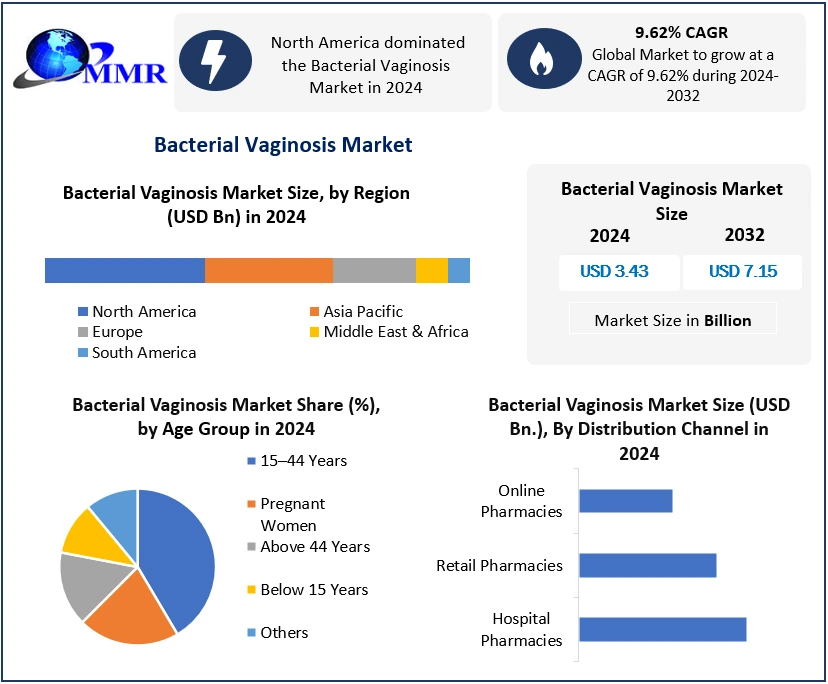
Bacterial Vaginosis Market
Bacterial vaginosis drives a USD 7.15 Bn market by 2032, fueled by rising awareness, better access, and innovation reshaping women’s health care.
"The bacterial vaginosis market grows because clinical and commercial attention is finally being paid to a condition once dismissed as a minor inconvenience.," says Maximize Market Research.”
ROCKVILLE , MD, UNITED STATES, May 5, 2026 /EINPresswire.com/ -- Market Estimation— Maximize Market Research
Global Bacterial Vaginosis Market was valued at USD 3.43 Billion in 2024 and is projected to reach USD 7.15 Billion by 2032, growing at a CAGR of 9.62% from 2025 to 2032. Growth is driven by the rising global prevalence of bacterial vaginosis, increasing awareness around women's reproductive health, expanding healthcare access in emerging markets, and continuous advancement in antibiotic and OTC treatment options.
Get Full PDF Sample Copy of Report: (Including Full TOC, List of Tables & Figures, Chart) @ https://www.maximizemarketresearch.com/request-sample/189624/
The Most Common Vaginal Infection the World Still Underdiagnoses Is Becoming a USD 7 Billion Market
Bacterial vaginosis affects an estimated 84.5% of women with no symptoms, making it one of the most silently prevalent reproductive health conditions globally. In the U.S. alone, 31.2% of women aged 14 to 49 are estimated to have BV, with prevalence reaching 51% among African American women. Despite this scale, BV remains chronically underdiagnosed. As women's health awareness accelerates and pharmaceutical investment in next-generation therapies grows, the Global Bacterial Vaginosis Market is transitioning from a historically overlooked clinical niche into a high-growth global healthcare segment.
Rising Prevalence and Women's Health Awareness: What Is Powering the 9.62% CAGR
Escalating Global BV Prevalence
BV is the most common vaginal infection among reproductive-age women worldwide, driven by hormonal fluctuations during menstruation, pregnancy, and menopause; broad-spectrum antibiotic overuse that disrupts protective Lactobacillus strains; and poor hygiene awareness sustaining recurrence. The burden falls disproportionately on non-white women, with African American women recording 51% prevalence versus 23% among white women in the U.S., creating targeted opportunities for culturally tailored diagnostics and treatment access programs.
Growing Awareness of Women's Reproductive Health
Government-backed and nonprofit women's health awareness initiatives are shifting diagnosis and treatment-seeking behavior across North America and Europe. Programs such as Cervical Health Awareness Month build health literacy that extends to vaginal infection education, increasing the number of women proactively consulting gynecologists. Rising diagnosis rates directly translate into higher prescription antibiotic volumes, OTC product sales, and specialty clinic visits across high-income markets.
Advancement in Treatment Options and Drug Development
The pharmaceutical pipeline is expanding beyond conventional metronidazole and clindamycin therapies. Investment in novel antibiotic formulations, probiotic-based microbiome restoration, and extended-release delivery systems targets the core clinical challenge: BV recurrence. Without sustained microbiome correction, BV returns in a large proportion of treated patients, creating a recurring demand cycle sustaining both prescription and OTC market segments throughout the forecast period.
High Treatment Costs and Low Symptom Awareness: What Is Limiting Market Growth
Two barriers constrain market penetration. The high cost of BV diagnostics and treatment creates access inequity in markets without universal health coverage, with laboratory tests and brand-name antibiotics driving treatment avoidance among lower-income patients. The asymptomatic nature of BV in 84.5% of cases means most women are never diagnosed, suppressing demand in regions with limited gynecological screening. Low health literacy compounds this challenge in rural and developing-market settings.
OTC Expansion, Emerging Markets and Microbiome Science: Opportunity Corridors Through 2032
Three corridors are reshaping the Bacterial Vaginosis Market. Expanding OTC vaginal care products extend treatment access beyond prescription channels to women who cannot access clinical care. Asia-Pacific's improving healthcare infrastructure is unlocking a large underserved patient base as urbanization and lifestyle changes elevate regional BV incidence. Most transformatively, vaginal microbiome science is building a next-generation pipeline of probiotic and biome-restoration therapies that address BV's root cause, command premium pricing, and reduce long-term recurrence rates.
Segment Intelligence
The Global Bacterial Vaginosis Market is segmented by age group, test type, treatment type, distribution channel, and end user. The 15 to 44 years group dominates with a projected 41.5% share by 2032, driven by peak reproductive-age BV prevalence. Antibiotics lead treatment type, with metronidazole at a CAGR of 8.25% and clindamycin expanding as a validated alternative. Hospital pharmacies lead distribution, while online pharmacies are the fastest-growing channel. Specialty clinics lead end-user revenue as gynecology practices expand women's health service portfolios.
By Age Group
Below 15 Years
15 to 44 Years (Dominant Segment, 41.5% share by 2032)
Above 44 Years
Pregnant Women
Others
By Test Type
Point-of-Care Testing
Laboratory Testing
Others
By Treatment Type
Antibiotics (Metronidazole, Clindamycin, Tinidazole, Others)
Over-the-Counter Products (Creams, Gel, Pills, Solution/Washes, Injection, Others)
Others
By Distribution Channel
Hospital Pharmacies
Retail Pharmacies
Online Pharmacies
By End User
Hospitals
Homecare
Specialty Clinics
Others
Get Full PDF Sample Copy of Report: (Including Full TOC, List of Tables & Figures, Chart) @ https://www.maximizemarketresearch.com/request-sample/189624/
Regional Insights
North America: Dominant Market Leader
North America leads the Global Bacterial Vaginosis Market, growing at a CAGR of 10.25%. The U.S. records 20.1% BV prevalence among women overall, rising to 35.1% among symptomatic pregnant women. The region benefits from widespread gynecological screening, robust insurance coverage for diagnostics and treatment, and the highest concentration of pharmaceutical R&D in women's reproductive health, sustaining revenue leadership through 2032.
Asia-Pacific: Fastest-Growing Region
Asia-Pacific is the most dynamic growth frontier. Rapid urbanization and adoption of Western lifestyles are elevating BV incidence across China, India, Indonesia, and Southeast Asia. Expanding gynecological care access is improving diagnosis rates in markets that were previously clinical blind spots. The region's large reproductive-age female population, rising health literacy, and improving insurance penetration position Asia-Pacific for the highest CAGR globally through 2032.
Four Trends Redefining the Bacterial Vaginosis Market
Microbiome-Based Therapy Development: The recognition that BV is fundamentally vaginal microbiome dysbiosis is driving investment in probiotic therapies and Lactobacillus-based interventions. These approaches address the recurrence root cause that antibiotics cannot resolve, commanding premium pricing and creating new segments beyond conventional treatment channels.
Telehealth and Online Pharmacy Expansion: Telemedicine and discreet online pharmacy channels are removing the stigma and access barriers that historically prevented women from seeking BV care. Direct-to-patient prescription delivery and online OTC sales are extending market reach into demographics previously underserved by traditional clinical infrastructure.
Point-of-Care Diagnostic Innovation: Rapid point-of-care BV testing advances are enabling diagnosis in primary care and community health settings without laboratory dependence. Faster diagnosis translates directly into faster treatment initiation, reducing untreated BV burden and expanding both prescription and OTC market demand.
Recurrence Management Products: High BV recurrence after antibiotic treatment is creating a largely untapped maintenance and prevention market.
Companies are developing pH maintenance products, suppressive antibiotic regimens, and probiotic protocols that convert single-episode patients into long-term recurring purchasers, significantly raising patient lifetime value.
Competitive Landscape
The Global Bacterial Vaginosis Market is moderately fragmented across pharmaceutical majors, specialty women's health companies, and generic manufacturers. Pfizer, Merck, GlaxoSmithKline, and Johnson & Johnson lead on antibiotic brand equity and global distribution. Bayer AG and AbbVie invest actively in women's health R&D. Indian generics manufacturers Sun Pharma, Dr. Reddy's, Aurobindo, and Lupin drive affordability in emerging markets. The competitive frontier is defined by investment in microbiome therapies and OTC recurrence prevention products.
Bacterial Vaginosis Market Key Players
Pfizer Inc.
Mylan N.V.
Merck & Co., Inc.
Novartis AG
GlaxoSmithKline plc.
Johnson & Johnson
Eli Lilly and Company
Sun Pharmaceutical Industries Ltd.
Reddy's Laboratories Ltd.
Hikma Pharmaceuticals plc
Aurobindo Pharma
AbbVie Inc.
Bayer AG
Lupin
Mission Pharmacal Company
Melinta Therapeutics, Inc.
Bristol-Myers Squibb Company
Sanofi S.A.
Abbott Laboratories
Perrigo Company plc.
Get access to the full description of the report @ https://www.maximizemarketresearch.com/market-report/bacterial-vaginosis-market/189624/
FAQs
Q1. What is the size and growth forecast of the Global Bacterial Vaginosis Market?
Valued at USD 3.43 Billion in 2024, the market is projected to reach USD 7.15 Billion by 2032 at a CAGR of 9.62%, driven by rising BV prevalence, women's health awareness, and treatment innovation.
Q2. Which age group dominates the Bacterial Vaginosis Market?
The 15 to 44 years segment dominates with a projected 41.5% share by 2032, driven by peak reproductive-age BV prevalence, hormonal fluctuations, and highest healthcare engagement rates.
Q3. Which treatment type leads the Bacterial Vaginosis Market?
Antibiotics lead, with metronidazole at a CAGR of 8.25% and clindamycin expanding as a validated alternative. OTC products are the fastest-growing treatment segment via telehealth and online pharmacy adoption.
Q4. Which region leads the Global Bacterial Vaginosis Market?
North America leads at a CAGR of 10.25%, backed by strong infrastructure and insurance coverage. Asia-Pacific records the fastest overall growth through 2032.
Q5. Who are the leading players in the Bacterial Vaginosis Market?
Pfizer, Merck, GlaxoSmithKline, Johnson & Johnson, AbbVie, Bayer AG, Sun Pharma, Dr. Reddy's, and Aurobindo Pharma are among the leading players shaping the competitive landscape.
Analyst Perspective
Analysts identify a 9.62% CAGR powered by three structural forces: the enormous scale of undiagnosed BV creating latent demand, expanding healthcare infrastructure in Asia-Pacific and Latin America unlocking previously unreached patient populations, and a pharmaceutical pipeline pivoting from episodic treatment toward microbiome restoration and recurrence prevention. The most significant commercial opportunity through 2032 lies in OTC consumer health products and digital health-enabled treatment delivery, both removing the access and stigma barriers suppressing true market demand. North America sustains revenue leadership through insurance coverage and awareness programs, while Asia-Pacific delivers the highest growth velocity.
Related Reports
Artificial Intelligence in Remote Patient Monitoring Market: https://www.maximizemarketresearch.com/market-report/artificial-intelligence-in-remote-patient-monitoring-market/281443/
Artificial Intelligence in Remote Patient Monitoring Market by Offering, Technology, Application, End-User, and Region. Global Forecast to 2030
Antiviral Therapeutics Technologies Market: https://www.maximizemarketresearch.com/market-report/global-antiviral-therapeutics-technologies-market/84971/
Antiviral Therapeutics Technologies Market by Product, Technology, Application, and Region. Global Forecast to 2032
Global Antibiotics Market: https://www.maximizemarketresearch.com/market-report/global-antibiotics-market/100206/
Global Antibiotics Market by Drug Class, Spectrum of Activity, Route of Administration, End User, and Region. Global Forecast to 2032
Top Reports:
Bone Harvester Market
Healthcare Specialty Enzymes Market
About Maximize Market Research Pvt. Ltd.
Maximize Market Research is a premier global consulting firm headquartered in Pune, India. Serving clients across 45+ countries, MMR delivers high-granularity market intelligence across Healthcare, Life Sciences, Medical Devices, Biotechnology, and Consumer Health, empowering enterprises with data-driven insights to make strategic decisions with confidence.
Domain Focus
This report falls under Maximize Market Research's Healthcare and Life Sciences domain, covering women's reproductive health therapeutics, vaginal infection management, antibiotic markets, OTC consumer health products, and gynecological diagnostics across 45+ countries, delivering the intelligence pharmaceutical companies, specialty healthcare providers, investors, and policy makers need to navigate the evolving global bacterial vaginosis market through 2032.
Lumawant Godage
MAXIMIZE MARKET RESEARCH PVT. LTD.
+91 96073 65656
akash.r@maximizemarketresearch.com
Visit us on social media:
LinkedIn
Instagram
Facebook
X
Legal Disclaimer:
EIN Presswire provides this news content "as is" without warranty of any kind. We do not accept any responsibility or liability for the accuracy, content, images, videos, licenses, completeness, legality, or reliability of the information contained in this article. If you have any complaints or copyright issues related to this article, kindly contact the author above.
